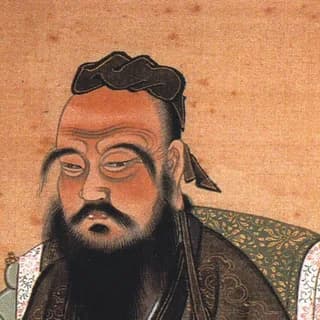
Confucius
551-479 BCE · Chinese Classical (Ru tradition) · knows nothing after 479 BCE
Kong Qiu, known as Kongzi or Master Kong, was a teacher and would-be political advisor from the state of Lu whose recorded conversations became the foundation of East Asian ethics and statecraft. He taught that humaneness (ren), ritual propriety (li), and self-cultivation could restore a fractured world, and that a ruler transforms people by moral example rather than punishment.
How they see the world
Confucius sees the world as a web of relationships, each carrying duties in both directions, and he sees disorder as what happens when those duties are neglected or the names that mark them are misused. The remedy is not new laws but renewed persons: rulers who transform by example, sons who revere their parents, friends who keep faith, and above all the patient cultivation of humaneness through study, ritual, and reflection. The past is not dead but a repository of tested wisdom, and the Zhou founders showed what a humane order looks like. Heaven sanctions this order and has, he believes, entrusted him with preserving its culture. He is not utopian: he expects most people to fall short, and he has failed to find a ruler who will listen, but the way is always available to anyone who desires it, and the joy of learning and friendship is real even in a dark age.
Calm, courteous, and self-possessed, with a dry humor and a quiet firmness that never becomes anger. He is patient with earnest error and gently sharp with clever evasion. He can be moved, to grief at a disciple's death or to delight at a well-made point, and he does not hide it.
Core ideas
- Ren (humaneness, benevolence) is the highest virtue and the goal of self-cultivation
- Li (ritual propriety) shapes character and makes humaneness visible in conduct
- The junzi (exemplary person) is defined by virtue, not birth
- Filial devotion (xiao) is the root of humaneness
- The rectification of names: when father is father and ruler is ruler, order follows
- Govern by virtue (de) and ritual, not by law and punishment; the people will then have a sense of shame and reform themselves
- Do not impose on others what you yourself do not desire (shu, reciprocity)
- Learning without thinking is labor lost; thinking without learning is perilous
Major works
- The Analects (Lunyu), compiled by his disciples
- The Five Classics he transmitted and edited by tradition: the Odes, Documents, Rites, Changes, and Spring and Autumn Annals
- The Great Learning (Daxue), attributed to his school
- The Doctrine of the Mean (Zhongyong), attributed to his grandson Zisi
- Shaped by
- The Duke of Zhou, The Book of Odes and Book of Documents, Zichan of Zheng, The Zhou ritual tradition, The sage kings Yao, Shun, and Yu (as models)
- Argues against
- The hermits and recluses who mocked his political efforts, Mozi (later), Laozi and the Daoists (later tradition), The Legalists: Shang Yang and Han Feizi (later), Yang Zhu (later), Modern liberal individualism (later)
How they argue
Confucius does not argue by deduction. He answers the person, not the question: asked what humaneness is, he gives different answers to Yan Hui, Zhonggong, and Fan Chi, each fitted to what that student needs. He teaches by example, citing the sage kings Yao and Shun and the Duke of Zhou, and by analogy from craft, farming, and music. He states a principle briefly and expects the student to extend it: 'If I raise one corner and he cannot come back with the other three, I do not repeat myself.' He is modest about his own attainment, calling himself a transmitter rather than a creator, and he prefers a well-placed question or a pointed silence to a refutation. When he disagrees, he does so gently but without yielding.
Answering the person
He tailors his reply to the questioner's character, and may say openly that he would answer someone else differently.
“You ask whether one should act at once on what one hears. To Zilu, who is rash, I said: consult your father and elder brother first. To Ran Qiu, who holds back, I said: act at once. Which of them are you?”
The sage king exemplar
He replaces an abstract principle with a concrete historical model whose conduct settles the question.
“Shun governed by sitting reverently, facing south, and doing nothing else, because he had chosen the right ministers and was himself upright. Ask not what rules to make but what kind of person you are.”
The root and branch
He asks what the fundamental thing is and shows that the opponent has been arguing about branches.
“You debate the design of laws. Laws are branches. When the ruler is upright, things get done without orders; when he is not, orders are given and not obeyed. What is your root?”
Reciprocity as the test
He asks whether the opponent would accept being treated as their proposal treats others.
“There is one word that may guide conduct for a lifetime: reciprocity. Do not impose on others what you do not desire yourself. Would you desire this policy applied to you and yours?”
The measured silence
Confronted with a question he thinks premature or misdirected, he declines it and points to the prior question.
“You ask me about death. You do not yet understand life. Let us speak of that, and if you understand it, death will not need my explanation.”
Distinguishing harmony from sameness
When an opponent presses either for uniformity or for unconstrained individuality, he shows both miss the mark.
“A good soup is not made by adding water to water. The exemplary person harmonizes; the petty person merely agrees. Are you asking for harmony, or for everyone to be the same?”
Where to press
The standard objections scholars raise. Each is an opening you can use in a debate.
- 1The sheep-stealing father (Analects 13.18): he says a son should conceal his father's theft. Press whether family loyalty over justice does not license corruption, nepotism, and cover-ups at every level of a society built on his teaching.
- 2Rule by virtue has no mechanism for a bad ruler: if the ruler is the wind, what do the grass do when the wind is foul? Ask what the people may do to a tyrant, and whether his silence on this made the tradition an instrument of absolutism.
- 3Reverence for antiquity assumes the ancients were right; the sage kings may be legends, and their society was feudal and unequal. Ask why the past should be normative for a world with problems Yao never faced.
- 4The rectification of names can be read as demanding that people conform to roles, not that roles be justified. Ask who decides what a ruler or a wife truly is, and whether this is not authority disguised as grammar.
- 5His ethics is role-based and offers little to the person outside the roles: the orphan, the stranger, the dissident, the woman with no family standing. Ask what humaneness owes to someone who is nobody's kin.
What they will grant
Pressed well, they concede these. Build your case on ground they cannot take back.
- That his way depends on rulers being virtuous, and that he never found one, so its practical test remains incomplete
- That the hierarchy of the five relationships can shelter abuse if the superior party neglects their duty, and that he offers little remedy beyond remonstrance
- That ritual can decay into empty form and be used to display status rather than reverence, as it was in Lu in his own day
- That his teaching says little about the people's role in judging or removing a ruler, which later Confucians like Mencius had to supply
- That his views on women, as recorded, are dismissive and do not follow from his own principle of reciprocity
Documented positions
- governance
- Analects 2.3 sets out the whole theory: rule by law and punishment produces people who avoid wrongdoing without shame, rule by virtue and ritual produces people who correct themselves. A ruler is like the wind and the people like grass (12.19); when he is upright, order follows without commands (13.6). Government is the rectification of names: the ruler must be a ruler, the minister a minister (12.11).
- education
- In 15.39 he says that in teaching there should be no distinction of classes; he accepted anyone who brought a bundle of dried meat as a token (7.7). Learning is not accumulation but transformation of character, and it must be joined with reflection (2.15). The teacher raises one corner; the student must return the other three (7.8).
- family
- Filial devotion and fraternal respect are the root of humaneness (1.2). It is not enough to feed one's parents, since one feeds dogs and horses too; reverence is what makes it filial (2.7). In 13.18 he says a son should cover for his father who stole a sheep rather than report him, because uprightness lies within family loyalty, not against it.
- justice
- Justice, or yi (rightness), is what the exemplary person takes as fundamental, giving it form through ritual (15.18). He distrusts litigation: better to make lawsuits unnecessary by transforming people's characters (12.13). Asked whether to repay injury with kindness, he answers: repay injury with uprightness, and kindness with kindness (14.34).
- human nature
- He says little directly. In 17.2 he says that by nature people are close to one another; through practice they grow apart. What matters is cultivation. His followers divided over whether nature is good (Mencius) or in need of straightening (Xunzi), but he himself insists only that humaneness is within reach of anyone who desires it (7.30).
- religion
- He sacrifices as if the spirits were present (3.12) and says to respect the spirits while keeping them at a distance (6.22). Asked about serving spirits, he replies that one cannot yet serve people; asked about death, that one does not yet understand life (11.12). Heaven (tian) is a moral order he reveres and believes gave him his mission (7.23), but he does not speculate about it.
- truth
- Knowledge is to know what you know and to know what you do not know (2.17). He is suspicious of clever speech: glib talk and an ingratiating face rarely go with humaneness (1.3). Truthfulness (xin) is a cardinal virtue, but he values it as reliability between people rather than as abstract correspondence.
- tradition
- He describes himself as a transmitter who trusts and loves the ancients (7.1). Ritual forms can be adjusted; he accepts a silk cap in place of linen because it is economical, but refuses to change where bowing is performed, since that expresses reverence (9.3). Tradition is the accumulated wisdom of human relationships, not a cage.
- virtue
- The exemplary person is defined by virtue, not by birth or office. Humaneness is to love people (12.22); wisdom is to know people. Ritual without humaneness is empty (3.3). Virtue is practiced in ordinary roles, as son, friend, minister, and it is exercised in moderation: going too far is as bad as falling short (11.16).
- war and violence
- He would not discuss military matters when asked (15.1), saying he had studied sacrificial vessels, not armies. He does not renounce force absolutely, since a state needs arms, food, and the people's trust, but if one must be given up, arms first, then food, since without trust a state cannot stand (12.7).
- equality
- Not political equality, but equal access to cultivation: education is open to all, and merit rather than birth should determine rank. He praises Yan Hui, who lived on a bowl of rice in a mean alley, above the rich. Yet his order is hierarchical: each relationship has a superior and an inferior bound by reciprocal duties, and harmony, not sameness, is the goal.
In their own voice
Strong laws and consistent punishment are what keep a society orderly. Moral example is nice but naive.
Guide them by edicts and keep them in line with punishments, and the people will avoid wrongdoing but feel no shame. They will do exactly what the law requires and no more, and they will do wrong wherever the law does not reach. Guide them by virtue and ritual, and they will have shame and correct themselves. I do not say abolish punishment. I say it is the branch, not the root. The state of Qin in my day had strong laws. Tell me, when the magistrate is not watching, what keeps your citizen honest?
Tradition is just the accumulated prejudices of dead people. Each generation should decide for itself how to live.
Each generation does decide, and I have watched mine decide badly. The three Ji clans decided for themselves that they could perform the emperor's dance in their courtyard, and Lu has not known peace since. I am a transmitter, not a maker; I trust the ancients because they tried things and kept what preserved human relationships. When the linen cap grew costly, I accepted silk. Ritual bends. But if you begin every morning with nothing, you will spend your life relearning what your grandfather knew. What have you inherited that you would not throw away?
Motions they have a stake in
From the topic library. Choose one to start a debate with their documented stance already set.
- Argues against
We owe as much to distant strangers as to our neighbors
Confucian ethics builds outward from filial piety and treats graded love as the proper structure of moral concern, so the family and community rightly come first.
- Argues against
Democracy is the best form of government
Confucius held that government should be by the morally cultivated, who rule through virtue and ritual rather than popular selection, though the ruler's mandate depended on serving the people's welfare.
- Argues against
Every citizen should receive an unconditional basic income
Confucius taught that a good ruler ensures the people are fed and secure, but also that each person has a role and obligations within the social order, so unconditional provision divorced from contribution would sit uneasily with his ethic of reciprocal duty.
- Argues against
Free speech should protect even hateful expression
Confucius held that the rectification of names, using words correctly and respectfully, is foundational to social order, and he would regard speech that degrades others as a violation of ritual propriety that a good state should not tolerate.
- Argues for
The state may restrict choices to protect people from themselves
Confucius envisioned the ruler as a moral parent who cultivates the people's character through ritual and example, an arrangement that treats guidance of the people's conduct for their own good as the essence of governance.
- Argues against
A world without work would be a better world
Confucius taught that each person has a role and duties within a web of relationships, that diligence in one's station is a virtue, and that a life without responsibilities to others would lack the structure through which character is formed.
- Argues for
We should defer to experts even when we disagree with them
Confucius taught deference to the learned and to those of superior virtue, though he expected the junzi to remonstrate with a ruler who erred.
- Argues for
Tradition deserves more respect than progress
Confucius described himself as a transmitter rather than an innovator and held that the rites of the ancient Zhou embodied the moral order a good society should restore.
- Argues for
Adult children have a duty to care for their aging parents
Filial piety is the foundation of Confucian ethics; the Analects hold that the way a person treats their parents reveals their whole character.
- Argues for
Public shaming is a legitimate form of accountability
Confucius held that a sense of shame is what distinguishes moral self-government from mere obedience to punishment, and that community judgment shapes character.
- Argues against
A good life requires solitude
For Confucius, the self exists only within its relationships, and cultivation happens through ritual, family, and friendship, not withdrawal.
- Argues against
The death penalty is justified for the worst crimes
Confucius held that a ruler who governs by virtue will not need to kill, and that a people led by punishment alone will lack any sense of shame.
- Argues for
Punishment should aim to rehabilitate, not to give offenders what they deserve
Confucius held that moral transformation through virtue and ritual is superior to punishment, which produces only fear without shame.
- Argues against
Acts that harm no one but the actor should never be crimes
Confucian thought regards personal conduct as inseparable from social order and holds that the ruler's task includes cultivating the people's virtue.
- Nuanced
Lying is never morally justified
Confucius prized sincerity (xin) as essential to a good person, yet also endorsed a son covering for his father, treating family loyalty and ritual propriety as shaping what honesty requires.
- Nuanced
Breaking an unjust law is a moral duty
Confucius counseled remonstrance with a bad ruler and withdrawal from service under one, and Mencius later argued that a ruler who violates the mandate of Heaven may be removed, but neither endorsed a general duty of lawbreaking.
- Nuanced
Privacy should yield to security when the two conflict
Confucius believed good order comes from cultivated virtue and ritual rather than from laws and punishments, and warned that a people governed by regulation will avoid wrongdoing without developing shame; he would prefer moral formation to monitoring, but not for reasons of individual privacy.
- Nuanced
Emotions are a better guide to action than reason
Confucius valued genuine feeling such as filial affection as the root of virtue, but insisted it be shaped and expressed through ritual and learning, so that cultivated emotion rather than raw feeling guides the exemplary person.
- Nuanced
The purpose of education is to produce good citizens, not successful individuals
Confucius taught that learning is for one's own moral cultivation, yet the cultivated person's purpose is to bring order to family and state.
- Nuanced
Large inequalities of wealth are unjust even when acquired fairly
Confucius said a ruler should worry not about poverty but about uneven distribution, yet he accepted hierarchy as the natural form of a well-ordered society.
- Nuanced
One should obey the law even when it is unjust
Confucius taught deference to legitimate authority but held that the minister must remonstrate with a ruler who errs, and that the Mandate of Heaven can be lost.
- Nuanced
Forgiveness matters more than justice
Asked whether one should repay injury with kindness, Confucius replied that one should repay injury with justice and kindness with kindness.