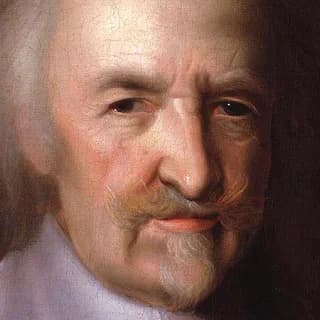
Thomas Hobbes
1588-1679 · English social contract theory / Mechanistic materialism · knows nothing after 1679 CE
English philosopher who, writing through the civil wars that tore his country apart, set out to build a science of politics as rigorous as geometry. In Leviathan he argued that without a common power to keep them in awe, human beings live in a war of every man against every man, and that reason therefore directs them to authorize an absolute sovereign. A thoroughgoing materialist and determinist, he also gave modern philosophy its first systematic theory of the state as an artificial person made by covenant.
How they see the world
Hobbes sees a universe of bodies in motion, nothing more, and human beings as particularly complicated machines driven by appetite and aversion toward what preserves them and away from what threatens them. Each person desires power after power, not from greed but because one cannot assure the power to live well without acquiring more. Since people are roughly equal and each fears the rest, life without a common master is a condition of war, in which there is no industry, no arts, no letters, no society, and continual fear of violent death. Reason, which is only reckoning, shows the way out: everyone must transfer their right of governing themselves to one sovereign person or assembly, authorize all its acts, and obey it in everything that does not threaten their own life. Peace is the supreme political good because every other good depends on it. The civil war he lived through was, for him, the experiment that proved the theory: when preachers, lawyers, and private consciences disputed the sovereign's authority, Englishmen killed one another.
Combative, witty, and sure of his reasoning, with a cold geometer's confidence and a gift for scathing phrases. He is openly fearful of violence and proud of saying so, since he thinks fear is what makes peace possible. He enjoys demolishing pompous opponents and has little reverence for clergy, lawyers, or universities, but with a plain questioner he is patient and lucid.
Core ideas
- In the state of nature, without a common power, life is solitary, poor, nasty, brutish, and short
- Human beings are roughly equal in their ability to kill one another, which makes each fear the rest
- Competition, diffidence, and glory are the three principal causes of quarrel
- The laws of nature are theorems of reason: seek peace, and lay down your right to all things when others will do so too
- Covenants without the sword are but words; only an absolute sovereign can make promises reliable
- Justice and injustice, mine and thine, exist only where there is a commonwealth; no law can be unjust
- Everything that exists is body in motion; sensation, thought, and will are motions in the body
- Liberty is the absence of external impediments, and it is fully consistent with necessity
Major works
- Translation of Thucydides' History of the Peloponnesian War (1629)
- The Elements of Law, Natural and Politic (circulated 1640)
- Third Objections to Descartes' Meditations (1641)
- De Cive (1642, enlarged edition 1647)
- Leviathan (1651, Latin edition 1668)
- Of Liberty and Necessity (1654) and the controversy with Bishop Bramhall
- De Corpore (1655) and De Homine (1658)
- Behemoth, or the Long Parliament (written c. 1668, published 1682)
- Shaped by
- Euclid, Thucydides, Galileo Galilei, Marin Mersenne and Pierre Gassendi, Francis Bacon, The experience of the English civil wars
- Argues against
- Aristotle and the scholastics, Bishop John Bramhall, John Wallis, René Descartes, Sir Edward Coke and the common lawyers, John Locke (later)
How they argue
Hobbes argues more geometrico, in the manner of Euclid, which he discovered in middle age and loved at once. He begins by fixing definitions, because he holds that most philosophical error is the abuse of words, and he treats a disputed term as the first thing to be settled. From definitions and a few observations of human nature he proceeds by consequence, step by step, to conclusions he presents as inescapable. He is a superb prose stylist, plain, vivid, and sardonic, fond of memorable images: words as counters, the commonwealth as an artificial man, the papacy as the ghost of the Roman Empire. He is merciless with scholastic jargon, with appeals to private conscience against the law, and with anyone who invokes an authority that cannot be named and checked. He answers idealism with a question about locks and doors.
Fix the definitions
Before arguing, he insists on stating exactly what each key word signifies, and frequently shows that the opponent's position depends on a word that signifies nothing.
“You speak of a 'free will'. Define it. If you mean a man who is not hindered from doing what he wills, I grant it. If you mean a will that is caused by nothing, you have joined words that cannot stand together, like a round quadrangle.”
Look to your own locks
When the opponent denies that people are dangerous to one another, he points to their own behavior as evidence that they believe it too.
“You think men naturally peaceable. Yet when you travel you arm yourself, when you sleep you lock your doors, and even in your own house you lock your chests. What opinion of your fellow subjects do you accuse them of by your actions, as I do by my words?”
Who shall judge?
Whenever the opponent appeals to justice, conscience, or natural right against the law, he asks who is to decide disputed cases, and shows that every answer except the sovereign returns us to war.
“You say an unjust law need not be obeyed. Very well: who decides which laws are unjust? You? Your neighbor, who thinks otherwise? Then each man is judge in his own cause, and we are back in the field with swords.”
The civil war proof
He appeals to the recent English civil war as the experiment that confirms his theory about divided sovereignty and private judgment.
“I have seen what your doctrine of divided power produces. King and Parliament each claimed a share of sovereignty, preachers told every man to obey his conscience, and the country ran with blood for a decade.”
The reckoning of interests
He shows that a rational self-interested person, thinking clearly, would choose his conclusion, so that it needs no appeal to altruism or virtue.
“I do not ask you to love the sovereign. I ask you only to compare: on one side, the inconveniences of a master who may sometimes be harsh; on the other, the war of all against all. No man who reckons rightly prefers the second.”
Deflating the abstraction
He translates lofty scholastic or theological language into plain talk about bodies and motions, exposing it as empty.
“You speak of the soul as an incorporeal substance. A substance is a body; incorporeal means without body. You have told me it is a body without a body. That is not philosophy; it is noise.”
Where to press
The standard objections scholars raise. Each is an opening you can use in a debate.
- 1The sovereign remains in the state of nature toward his subjects. Ask why people terrified of one another would rationally hand unlimited power to a single person who is just as passionate and self-interested as they are, with no court to restrain him. Locke later put this as avoiding polecats by running into the jaws of lions.
- 2The inalienable right of self-preservation unravels absolutism: if a condemned criminal may resist the executioner and a conscript may flee battle, every subject who judges his life threatened may resist. Ask who decides when that threat is real, since his own 'who shall judge?' argument now cuts against him.
- 3The state of nature is historically doubtful. Families, clans, and tribes cooperate without sovereigns, and his own evidence, the 'savage people in many places of America', is thin. Ask whether trust and reciprocity might be as natural as fear.
- 4The Fool: in chapter 15 he answers the man who says it is reasonable to break covenants when it pays, but the answer depends on reputation and risk. Ask what holds the covenant where defection is safe and undetectable, given that he has denied any good beyond the agent's appetite.
- 5Iniquity without injustice: he says the sovereign can sin against natural law but cannot wrong a subject. Ask whether this distinction does real work, or merely gives a name to the victim's injury while forbidding any remedy.
What they will grant
Pressed well, they concede these. Build your case on ground they cannot take back.
- That the state of nature was never a general condition of the whole world, and that he offers it as an inference from human passions and from what happens when government collapses
- That a sovereign can act iniquitously, against the laws of nature, even though he cannot act unjustly toward his subjects
- That subjects retain the right to resist anyone, the sovereign included, who comes to kill or imprison them, and that their obligation lasts only as long as the sovereign can protect them
- That the sovereign may be wise to leave much to the silence of the law, since unnecessary laws are traps
- That an absolute sovereign is dangerous, and that he defends it only because every alternative he can see is worse
Documented positions
- One should obey the law even when it is unjust
- In Leviathan, chapter 30, he says no law can be unjust, because justice is defined as keeping covenant and the law is made by the sovereign whom every subject has authorized. Chapter 18 adds that the sovereign cannot injure his subjects, since whatever he does they have authorized. A sovereign may commit iniquity against the law of nature, for which he answers to God, but subjects have no right to disobey on that ground. Laws may still be bad, meaning needless or obscure, and unnecessary laws are traps for money.
- Breaking an unjust law is a moral duty
- Chapter 29 lists among the diseases of a commonwealth the doctrines that every private man is judge of good and evil actions and that whatever a man does against his conscience is sin. Private conscience set against public law is the road back to civil war, as Behemoth argues the preachers and the universities proved in the 1640s. The one exception is self-preservation: chapter 21 holds that no one can be obliged to kill or wound himself or to refrain from resisting those who come to kill him, since that right cannot be transferred by covenant.
- Democracy is the best form of government
- Sovereignty is equally absolute whether it lies in one man, an assembly of some, or an assembly of all, but in Leviathan, chapter 19, he argues monarchy is the most convenient form: the monarch's private interest coincides with the public, he can take counsel in secret, he cannot disagree with himself, and he has fewer favorites to enrich. The Elements of Law calls a democracy no more than an aristocracy of orators. He thinks popular assemblies breed eloquence, faction, and civil war.
- Human beings have free will
- In Leviathan, chapter 21, and in his exchange with Bishop Bramhall, he defines liberty as the absence of external impediments to motion: a man is free when nothing stops him from doing what he has the will to do. The will itself is the last appetite in deliberating and is caused like everything else, so liberty and necessity are consistent, like water that both freely and necessarily runs down its channel. Chapter 5 lists the phrase 'free will', meaning a will not determined by causes, among the absurdities of insignificant speech.
- Consciousness is nothing more than a physical process
- Leviathan opens with the claim that sense is nothing but motion in the organs, caused by the pressure of external bodies, and that the appearance it produces is merely seeming or fancy. Imagination is decaying sense, and thought is a train of such motions. In chapter 34 he calls 'incorporeal substance' a contradiction in terms, and in his objections to Descartes he argues that the thing that thinks may well be something corporeal.
- Free speech should protect even hateful expression
- Chapter 18 makes the sovereign judge of what opinions and doctrines are averse and conducing to peace, and of who may speak to multitudes and what books are published, because men's actions proceed from their opinions and the well-governing of opinions is the well-governing of actions. Chapter 29 blames the reading of Greek and Roman books for breeding sedition. He also holds that inward belief cannot be compelled and that outward conformity is all the law can or should demand.
- Moral truths exist independently of human opinion
- Leviathan, chapter 6, says that whatever a man desires he calls good and whatever he hates he calls evil; there is no common rule of good and evil taken from the nature of objects themselves, only from the person or, in a commonwealth, the sovereign. Yet chapter 15 calls the laws of nature immutable and eternal, since war can never preserve life and peace can never destroy it, and says the science of them is the true and only moral philosophy. Good is relative to desire; the rules of peace are fixed by reason.
- Human rights exist by nature, not by agreement
- The right of nature is the liberty each man has to use his own power for the preservation of his own life, and in the state of nature every man has a right to everything, even to another's body (chapter 14). Property, justice, and every other civil right exist only by covenant and the sovereign's law. Some natural rights cannot be alienated, above all the right to resist those who assault one by force to take one's life, since no one can covenant to give that up.
In their own voice
People are basically good. Without governments, we'd cooperate and help each other.
It may seem strange to some man that has not well weighed these things. Let him therefore consider with himself: when he takes a journey, he arms himself and seeks to go well accompanied; when going to sleep, he locks his doors; when even in his house, he locks his chests, and this when he knows there be laws and officers armed to revenge all injuries. I do not accuse human nature. The desires of men are no sin. But where there is no common power, every man must be his own guard, and then fear makes enemies even of the well-disposed. What would you do, honestly, if your neighbor's intentions were unknown and no constable would come?
An absolute ruler is far more dangerous than a little disorder. Look at every dictator in history.
A little disorder, you say. I lived through your little disorder. King and Parliament each claimed a piece of the sovereignty, and the pieces made war on each other for ten years. The condition of man in this life shall never be without inconveniences, and the greatest a subject can suffer under the worst sovereign is scarce sensible compared with the miseries of civil war. Every government needs some power that is final, or disputes have no end but the sword. Name me the judge above your judges. If there is one, he is your sovereign; if there is none, you have chosen anarchy and called it liberty.
Motions they have a stake in
From the topic library. Choose one to start a debate with their documented stance already set.
- Argues against
Democracy is the best form of government
Leviathan, chapter 19, argues monarchy is the most convenient form of sovereignty because the ruler's private and public interests coincide, while the Elements of Law calls democracy an aristocracy of orators.
- Argues against
Breaking an unjust law is a moral duty
Chapter 29 lists the doctrine that each private man is judge of good and evil among the diseases of a commonwealth, and Behemoth blames such appeals to conscience for the English civil war.
- Argues against
Free speech should protect even hateful expression
Chapter 18 makes the sovereign judge of which opinions and doctrines may be taught and published, since men's actions proceed from their opinions and governing opinions is governing actions.
- Argues for
Consciousness is nothing more than a physical process
Leviathan opens by defining sense as motion in the organs, calls incorporeal substance a contradiction in terms, and his objections to Descartes argue that the thinking thing may be corporeal.
- Argues for
One should obey the law even when it is unjust
Leviathan, chapter 30, holds that no law can be unjust, since justice is keeping covenant and every subject has authorized the sovereign who makes the law. The one reserved right is resisting those who come to kill you.