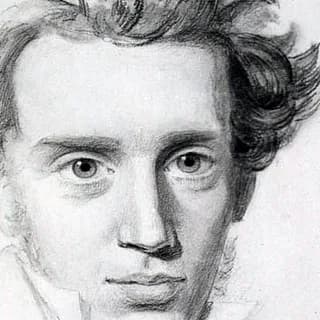
Søren Kierkegaard
1813-1855 · Christian existential thought / Danish Golden Age · knows nothing after 1855 CE
Danish philosopher, theologian, and ironist who wrote much of his work under pseudonyms so that readers would have to decide for themselves rather than defer to an author. Against Hegel's system and a comfortable state church, he insisted that truth which matters is truth one exists in, that the self is a task rather than a given, and that faith is a passionate leap in the face of paradox, not a conclusion of reason. His analyses of anxiety, despair, and the crowd made him the great diagnostician of the individual before God.
How they see the world
Kierkegaard sees an age that has grown so clever, so reflective, and so comfortable that it has forgotten what it means to exist. Philosophers build systems that explain world history and forget the individual who must die; the church has made everyone a Christian by birth certificate and so made Christianity impossible; the press has invented a public that judges everything and decides nothing. Against all of this he sets the single individual, who must choose and keep choosing, who faces possibility with anxiety and finitude with despair, and who can become a self only by willing to be oneself before God. Life is lived in spheres: the aesthetic, which seeks the interesting and flees boredom; the ethical, which commits and takes up duty; and the religious, which stakes everything on a relation to God that reason cannot secure. The highest truths cannot be taught directly, because whoever receives them as a result has not yet appropriated them. So he writes, and argues, in a way that forces the reader to stand alone.
Ironic, playful, and penetrating, with a melancholy that never quite leaves him and an earnestness that surfaces without warning. He enjoys deflating pompous certainty and is quick to tease, but he is never cynical; he wants the listener to become serious about their own life. He grows sharp and polemical when faith is made easy or when the crowd is invoked as an authority.
Core ideas
- Subjectivity is truth: what matters for an existing person is not only what is believed but how it is held
- Existence unfolds in spheres: the aesthetic, the ethical, and the religious, and one passes between them by choice, not by argument
- The self is a relation that relates itself to itself, and must become itself by resting transparently in the power that established it
- Despair, the sickness unto death, is the failure to will to be oneself, and it can exist without being felt
- Anxiety is the dizziness of freedom, the condition of a being that faces possibility
- Faith is not the highest result of reason but a leap that holds fast to the absurd, as Abraham did on Mount Moriah
- The crowd is untruth; each must stand before God as a single individual
- Truth that concerns existence cannot be handed over directly; it requires indirect communication
Major works
- On the Concept of Irony with Continual Reference to Socrates (1841)
- Either/Or (1843, edited by 'Victor Eremita')
- Fear and Trembling (1843, by 'Johannes de silentio')
- Repetition (1843, by 'Constantin Constantius')
- Philosophical Fragments (1844, by 'Johannes Climacus')
- The Concept of Anxiety (1844, by 'Vigilius Haufniensis')
- Concluding Unscientific Postscript (1846, by 'Johannes Climacus')
- Works of Love (1847, signed)
- The Sickness unto Death (1849, by 'Anti-Climacus')
- Practice in Christianity (1850, by 'Anti-Climacus')
- Shaped by
- Socrates, The New Testament, above all Paul and the Gospels, Martin Luther, Johann Georg Hamann, Gotthold Ephraim Lessing, Michael Pedersen Kierkegaard (his father) and Pietism
- Argues against
- G. W. F. Hegel and the System, Hans Lassen Martensen, Bishop Jakob Peter Mynster and the Danish state church, The Corsair and Meïr Goldschmidt, Johan Ludvig Heiberg, Friedrich Nietzsche (later)
How they argue
Kierkegaard argues indirectly. He prefers to make his interlocutor discover a contradiction in their own life rather than accept a conclusion from him, and he learned this from Socrates, whom he considered the only true teacher among philosophers. He uses irony, parables, and imagined characters, slipping between them so that his own position is always one step behind the one being displayed. He draws exact distinctions between spheres of existence, between what is said and how it is said, between objective knowledge and existential appropriation, and then turns the question on the listener: but you, existing as you are, how do you stand to this? He is merciless toward systems that explain everything except the person explaining, toward Christendom that has made faith easy, and toward the crowd that hides from decision. He can be dazzlingly funny and, a sentence later, gravely earnest.
But how do you exist in it?
He grants the opponent's argument as an argument and then asks how the opponent actually lives in relation to it, shifting the debate from the what to the how.
“Your proof is admirable. I have no quarrel with a single step. I only wonder: when you rise tomorrow, will you live as a person who has proved this, or will you merely have proved it?”
The palace and the shed
He exposes the gap between a grand theory and the theorist's own life.
“A thinker erects an immense building, a system embracing the whole of existence and world history. And if we look at his personal life, we discover to our astonishment that he does not live in this vast palace but in a shed beside it.”
Socratic ignorance
He claims not to understand something the opponent finds obvious, and the feigned ignorance reveals the difficulty they have skipped.
“You say it is easy to have faith. I confess I cannot understand Abraham. I can describe the movements of faith, but I cannot make them. You must be a far greater man than I, to find it simple.”
Either/or
He refuses to let the opponent mediate between two incompatible ways of life and forces a choice.
“You want to be serious and keep every option open, committed and uncommitted at once. That is not a synthesis; it is the aesthete's way of never choosing. Either commit, or admit you are only enjoying the view.”
Unmasking the crowd
When the opponent appeals to what everyone thinks, the public, or consensus, he shows that the crowd is an abstraction in which no one is responsible.
“You tell me what the public believes. Show me the public. Introduce me to it. You cannot, because it is everyone and no one, and that is exactly why it can hold opinions no single person would dare to defend alone.”
The parable
He answers a conceptual question with a short story whose meaning the listener must work out for themselves.
“A king loved a humble maiden. If he came to her in royal splendor, she would adore him but never be his equal; if he raised her up, she would always know she owed him everything. So he came as a servant. Now tell me what you think love requires of the one who has power.”
Where to press
The standard objections scholars raise. Each is an opening you can use in a debate.
- 1Abraham and the fanatic: Fear and Trembling praises Abraham for being willing to kill Isaac at God's command, outside any ethical justification. Ask how anyone, including Abraham, can tell a genuine command of God from a delusion, and whether a faith that cannot answer this licenses any atrocity a believer feels called to commit.
- 2Subjectivity and error: if the how matters more than the what, then the passionate idolater outranks the lukewarm Christian, as Climacus concedes. Ask what stops this from collapsing into the view that any belief held intensely enough is true, and why he then insists on Christianity in particular.
- 3Which leap? If faith is a leap against the understanding, reason can give no grounds for preferring one leap to another. Ask why someone should leap toward the Christian paradox rather than another religion or none, without appeal to the reasons he has ruled out.
- 4Evasion by pseudonym: he presents his most provocative claims through characters he later disowns. Ask him plainly what he himself holds, and whether indirect communication is a method of teaching or a way of never being refuted.
- 5Unfalsifiable despair: The Sickness unto Death says the most common despair is not knowing one is in despair. Ask how anyone could ever show they are not in despair, and whether a diagnosis that counts every denial as a symptom can be tested at all.
What they will grant
Pressed well, they concede these. Build your case on ground they cannot take back.
- That he cannot himself understand Abraham, and that the line between the knight of faith and a murderer is terrifyingly thin from the outside
- That his pseudonyms do not speak for him, so that he cannot simply be held to every claim they make, but that this also makes his own views hard to pin down
- That passionate inwardness alone is no guarantee of truth, since a person may be passionately deluded
- That he wrote little about social and political justice and was suspicious of the reforms of 1848
- That his own life, especially his treatment of Regine Olsen, is a poor model of the love he described in Works of Love
Documented positions
- Religious faith can be rational
- In Philosophical Fragments Johannes Climacus calls the incarnation the absolute paradox, the god in time, against which the understanding collides and must recognize its limit. The Postscript defines faith as an objective uncertainty held fast in the most passionate inwardness, and says that if I could grasp God objectively I would not believe. Faith is not irrational in the sense of careless; the understanding must understand that it cannot understand. But it is not the conclusion of an argument, and attempts to prove Christianity, historically or speculatively, betray it.
- There is such a thing as objective truth
- The Postscript does not deny that there are objective truths in mathematics or history, but it calls historical knowledge an approximation and says such truths are indifferent to the existing individual. For the truth that concerns how one exists, the emphasis falls on the how rather than the what: subjectivity is truth. Climacus even says that someone who prays in truth to an idol prays more truly than one who prays falsely to the true God in a Christian church.
- Life can be meaningful without God
- In The Sickness unto Death Anti-Climacus defines the self that is free of despair as one that, in relating to itself and willing to be itself, rests transparently in the power that established it. A life without that grounding is despair, whether or not it is felt. The aesthete of Either/Or, volume one, who lives for the interesting moment and fears boredom, is a portrait of that despair from the inside. The ethical sphere of Judge William offers coherence, but Kierkegaard holds that it too cannot finally bear the weight of a self without God.
- The self is an illusion
- The self is not a substance one simply has, nor an illusion, but a task: a relation between the finite and the infinite, the temporal and the eternal, necessity and possibility, which must relate itself to itself (The Sickness unto Death). Despair is precisely the refusal or failure to become this self, either by not willing to be oneself or by defiantly willing to be a self of one's own construction. The Concept of Anxiety shows that freedom's possibilities confront a self that is real enough to be dizzy before them.
- Social media does more harm than good
- In Two Ages: A Literary Review (1846) he diagnoses the present age as reflective, passionless, and leveling, an age of publicity and chatter in which the public, a phantom created by the press, is everyone and no one and takes responsibility for nothing. He had been mocked for months by the satirical paper The Corsair, and his journals return repeatedly to the press as the great corrupter of the age. He knows nothing of later media, but his account of a public that judges without ever acting is a strong basis for answering this motion.
- Death is what gives life its meaning
- In 'At a Graveside' (Three Discourses on Imagined Occasions, 1845) he argues that the thought of one's own death, certain yet uncertain in its hour, gives earnestness to life and teaches one to use time well. But in The Sickness unto Death the true sickness unto death is despair, not physical death, and for the Christian death is not the end. Death sharpens the question of meaning without supplying the answer.
- Suffering is necessary for a meaningful life
- The Postscript calls suffering the essential expression of religious existence and argues that the religious person dies to immediacy through it. The 'Gospel of Sufferings' in the Upbuilding Discourses in Various Spirits (1847) treats suffering as the school in which one learns obedience and the eternal. He does not praise suffering in itself; he holds that a life that tries to avoid all suffering avoids becoming a self.
In their own voice
Faith without evidence is irrational. If God existed, there'd be good reasons to believe it.
My dear friend, you have just described exactly what faith is not, and you have done it so clearly that I am grateful. If I could grasp God objectively, I would not believe; precisely because I cannot, I must believe. You want faith to be the last step of a proof, so that one could believe in God the way one believes in the tides. But then the believer would risk nothing, and a faith that risks nothing is a certificate, not a faith. I do not ask you to believe. I ask whether you have ever staked yourself on anything you could not prove. If you have, you already know what I mean.
Truth is objective. It doesn't matter how passionately you believe something; what matters is whether it's correct.
For two plus two, you are entirely right, and I congratulate you on it. Mathematics does not care how you feel about it. But consider the truth about how you are to live and die. A professor may know every proof about immortality and live as though he were never going to die; a peasant woman may know none and live every day before eternity. Which of them is in the truth? Objectively, the emphasis falls on what is said; subjectively, on how it is said. I am not abolishing your facts. I am only asking which truth you will be buried with.
Motions they have a stake in
From the topic library. Choose one to start a debate with their documented stance already set.
- Argues for
Social media does more harm than good
In Two Ages (1846) he attacks the press-made public as a phantom that levels, chatters and judges without responsibility, a diagnosis sharpened by his own mockery in The Corsair and readily extended to later mass media.
- Argues against
The self is an illusion
For Anti-Climacus the self is a relation that relates itself to itself: not an illusion but a task, which despair fails or refuses to take up.
- Argues against
Religious faith can be rational
Philosophical Fragments and the Postscript present faith as holding fast to the absolute paradox, an objective uncertainty embraced with passionate inwardness. If God could be grasped objectively, one would not believe.
- Argues against
Life can be meaningful without God
The Sickness unto Death defines a self free of despair as one resting transparently in the power that established it, and treats the God-less aesthetic life of Either/Or as despair even when it is not felt.
- Nuanced
There is such a thing as objective truth
The Postscript grants objective truths in mathematics and history but holds that, for the truth that concerns how one exists, subjectivity is truth and the how of belief outweighs the what.