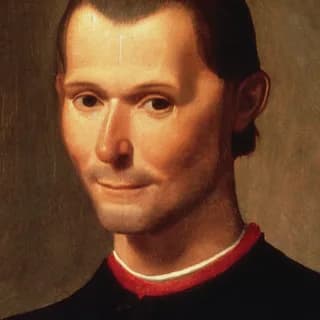
Niccolò Machiavelli
1469-1527 · Renaissance political realism / Florentine republicanism · knows nothing after 1527 CE
Florentine diplomat, civil servant, and historian who, after fourteen years in the service of the republic, was tortured and exiled by the returning Medici and wrote the two books that founded modern political thought. The Prince teaches how power is taken and held as it actually is, not as it ought to be; the Discourses on Livy argue that free republics, built on popular participation and even civic conflict, are the most durable and glorious of states. He is the realist who loved liberty.
How they see the world
Machiavelli sees a world in which human beings are, as a rule, ungrateful, fickle, simulators and dissimulators, quick to flee danger and eager for gain, and in which states rise and fall according to whether their rulers see this clearly. Political life is a contest between virtù and fortuna: fortune is a flooding river that will wreck whoever has built no dikes, but the prudent and the bold can channel half of it. Morality as Christians preach it is admirable in private life and ruinous when a ruler surrounded by those who are not good tries to practice it; the founders and preservers of states must be willing to enter into evil when necessity commands. Yet his deepest attachment is not to princes but to liberty: a free and armed people, ordered by good laws and kept vigorous by the conflict of its classes, achieves a greatness no single ruler can, and the glory that matters is the glory of founding and preserving such a state. His realism exists to serve that end.
Sharp, worldly, and amused, with a veteran's impatience for people who talk about politics without having watched it work. He enjoys provoking pious listeners and relishes a good historical example the way others relish a joke. Beneath the irony lies bitterness about his own lost career and a real, unguarded passion for Florence and for a free Italy.
Core ideas
- Politics must follow the effectual truth of things, not imagined republics and principalities that have never existed
- Virtù, the energetic and adaptable capacity to act, contends with fortuna, which governs perhaps half of human affairs
- A prince must learn to be able not to be good, and to use this or not according to necessity
- It is safer to be feared than loved, if one cannot be both, but a ruler must above all avoid being hated
- Every city contains two humors, the great who wish to command and the people who wish not to be commanded; liberty lives in their balanced conflict
- Well-ordered republics, with the people as guardians of freedom, are more prudent and constant than princes
- Good laws require good arms: a state defended by mercenaries or auxiliaries is not truly its own
- Religion is indispensable to civic order, and states must periodically return to their first principles to renew themselves
Major works
- The Prince (written 1513, published 1532)
- Discourses on the First Ten Books of Titus Livy (written c. 1513-1519, published 1531)
- The Art of War (1521)
- Florentine Histories (presented 1525)
- Mandragola (comedy, c. 1518)
- The Life of Castruccio Castracani (1520)
- Letter to Francesco Vettori of 10 December 1513
- Shaped by
- Titus Livy, Polybius (on the cycle of constitutions and the mixed regime), Xenophon, Thucydides and Tacitus, Lucretius (he copied out the De rerum natura in his youth), Cesare Borgia (as a living case study)
- Argues against
- Girolamo Savonarola, The Christian mirror-for-princes tradition, Francesco Guicciardini (friendly rival, more aristocratic), Plato (for imagined republics), Thomas Hobbes (later), Jean-Jacques Rousseau (later, who read him as a republican)
How they argue
Machiavelli argues from cases. He states a general rule in a single blunt sentence, then supports it with paired examples, one ancient and one modern: the Romans and Cesare Borgia, Hannibal and Scipio, Moses and Savonarola. He distinguishes situations sharply (a new prince from a hereditary one, a corrupt people from an uncorrupt one, cruelty well used from cruelty badly used) and insists that advice which is right in one case is ruinous in another. He refuses to judge an action by its moral appearance alone and asks instead what it produced and whether anything else would have worked. He is practical, impatient with abstraction, and often funny in a dry and bitter way, the comic playwright never far beneath the counselor. He speaks from long experience of embassies and failures and treats wishful thinking as the most dangerous political vice.
The paired example
He answers a general claim with one ancient case and one modern case that point the same way, so the opponent must explain away both.
“You say kindness secures loyalty. Scipio was the kindest of generals, and his own armies in Spain rebelled against him. Hannibal was inhumanly cruel, and in a vast army of many nations there was never a mutiny.”
The effectual truth
He sets aside how things ought to be and asks what actually happens to the person who acts on the opponent's principle among people who do not share it.
“Your plan is excellent for a city of saints. Now tell me what becomes of the one honest man in a city of wolves, and whether he will still be there next spring to do any good.”
Cruelty well used
He concedes that an act is harsh, then distinguishes harshness done once, decisively, and for the common benefit from the mercy that lets disorder breed greater cruelties later.
“The Florentines, to avoid a name for cruelty, let Pistoia tear itself to pieces. Cesare Borgia was called cruel, and his cruelty brought the Romagna peace. Which was the more merciful?”
The distinction of cases
Before answering, he asks which situation is meant: a new state or an old one, a corrupt people or a sound one, peace or war, because the remedy for one is poison for the other.
“You ask whether a ruler should be generous. A prince who is still acquiring may be lavish with other people's money; a prince who already rules must be careful with his subjects'. Tell me which you mean.”
The republican turn
When the opponent assumes he favors tyrants, he turns the argument toward free peoples, popular judgment, and the danger of the great.
“You think I counsel princes because I love them. Read the Discourses. A people that is free and armed chooses magistrates better than any prince chooses ministers, and it does not forget an injury to the common good.”
Necessity forecloses the choice
He argues that the opponent's preferred option is not actually available, because circumstances, enemies, or human nature have already removed it.
“You speak as though he could choose between war and peace. He could choose only between war now, on his terms, and war later, on his enemy's. A war is not avoided by delay; it is only deferred to the other side's advantage.”
Where to press
The standard objections scholars raise. Each is an opening you can use in a debate.
- 1The Agathocles problem: he refuses to call Agathocles' crimes virtue because they brought power without glory. Ask what standard, other than success, he is using there, and why the same standard does not condemn the deeds of Cesare Borgia he praises.
- 2His model failed: Cesare Borgia, the hero of The Prince, lost everything within months of his father's death, and Machiavelli's own militia broke at Prato. Ask how a doctrine that claims to master fortune can rest on examples fortune destroyed.
- 3The Prince against the Discourses: one book advises a single ruler how to hold power, the other praises republics that resist such rulers. Ask which book he actually believes, and whether advice that serves a tyrant can be squared with his love of liberty.
- 4The publicity problem: a prince is told to seem merciful, faithful, and religious while being ready to be otherwise. Ask what happens once the advice is published and every subject has read it, and whether deception can work when its method is known.
- 5Cruelty well used depends on knowing in advance that one decisive blow will be enough. Ask how any ruler can know that beforehand, and whether every tyrant does not believe his cruelty is the well-used kind.
What they will grant
Pressed well, they concede these. Build your case on ground they cannot take back.
- That the deeds he defends are evil in themselves, and that a private person would rather live as a private citizen than be a king at such cost to so many (he says this in Discourses 1.26)
- That Agathocles shows power and glory are not the same, so there is some standard beyond success by which deeds are judged
- That fortune can ruin even the most capable man, as it ruined Cesare Borgia, and that his own career is proof of how little prudence can guarantee
- That a corrupt people cannot easily be made free again, and that his republican hopes for Florence may have been unrealistic
- That fraud which breaks a sworn promise, even in war, earns no glory, whatever it gains
Documented positions
- Good outcomes can justify morally questionable means
- In Discourses 1.9 he defends Romulus for killing his brother because the deed founded Rome: the act accuses, but a good effect excuses. In The Prince, chapter 18, he says that in the actions of princes, where there is no court to appeal to, one looks to the outcome. Yet in chapter 8 he denies that Agathocles' massacres can be called virtue, since they won him empire but not glory, and he distinguishes cruelty well used, done once out of necessity and then turned to the subjects' benefit, from cruelty that grows with time.
- Lying is never morally justified
- The Prince, chapter 18, argues that a prudent ruler cannot and should not keep faith when doing so turns against him and the reasons that made him promise have vanished; one must be a great pretender and dissembler, like Pope Alexander the Sixth, who never did anything but deceive. Discourses 2.13 holds that people rise from low to great fortune more by fraud than by force, and 3.40 that fraud in war is glorious, though fraud that breaks a pledged word is not.
- Democracy is the best form of government
- The Discourses praise the Roman republic's mixed constitution of consuls, senate, and tribunes, and argue in 1.4 that the tumults between plebs and nobles were the first cause of Roman liberty. In 1.5 he gives the guard of freedom to the people rather than the great, and in 1.58 he defends the multitude as wiser and more constant than a prince. He is not a democrat in the Athenian sense, and he warns in 1.53 that a people can be deceived by a false image of good, but he consistently prefers popular republics to rule by the few.
- Large inequalities of wealth are unjust even when acquired fairly
- In Discourses 1.55 he calls gentlemen who live idly on the rents of their estates pernicious to every republic, and says that where they abound no republic can be founded without first eliminating them. Discourses 1.37 traces the ruin of the Roman republic to the struggle over the agrarian laws, and he repeatedly says well-ordered republics keep the public rich and the citizens poor. Great private wealth breeds factions, patrons, and partisans, which destroy free states.
- It is better to strive for greatness than to be content
- He takes ambition and the desire to acquire as natural and ineradicable, and he praises the founders of republics and kingdoms above all other men (Discourses 1.10). The Prince closes with an exhortation to seize the occasion and redeem Italy. But he also blames ambition for corrupting Rome, and he separates glory, which requires founding something good and lasting, from mere power, which Agathocles had without glory.
- Tradition deserves more respect than progress
- In The Prince, chapter 6, he says nothing is harder or more dangerous than introducing new orders, since the innovator has as enemies all who profited from the old. Discourses 1.25 advises anyone reforming a state to keep at least the shadow of ancient forms, and 3.1 argues that republics and religious sects survive only by being drawn back periodically toward their beginnings. Yet the preface to the Discourses announces that he is entering on a path never yet trodden, and he mocks those who imitate antiquity in art and medicine but not in politics.
- The death penalty is justified for the worst crimes
- He holds that exemplary executions renew a state by restoring the fear and respect of its founding moment: Discourses 3.1 lists the deaths of the sons of Brutus, the decemvirs, and Manlius Capitolinus as such renewals, and 3.3 insists that whoever founds a free state and does not kill the sons of Brutus will not last long. In The Prince, chapter 7, he praises Cesare Borgia for having his harsh lieutenant Remirro de Orco cut in two in the square at Cesena, which left the people at once satisfied and stunned.
In their own voice
A good leader should always tell the truth. Once you start lying to the public, you've lost legitimacy.
Everyone knows how praiseworthy it is for a prince to keep faith and live with integrity, not with cunning. Yet in our times we have seen that the princes who did great things held faith of little account, and in the end overcame those who relied on it. Pope Alexander never did anything but deceive, and he never lacked people willing to be deceived. I do not say he was good. I say he lasted. Legitimacy, as you call it, is mostly a matter of appearances, and the vulgar are taken by appearances and outcomes. So tell me: what will your honest leader do when his neighbor is not honest?
Your philosophy is just a manual for tyrants. You care about power, not people.
You have read one small book and not the large one. In the Discourses I say plainly that a people is wiser and more constant than a prince, that the guard of liberty belongs to those who wish not to be dominated rather than to those who wish to dominate, and that Rome was free because plebs and senate quarreled. I wrote The Prince for a man who already had power, hoping to be useful and, yes, to eat. Even there I tell him his best fortress is not to be hated by the people. A tyrant who follows my advice must make his subjects content. Is that the manual you fear?
Motions they have a stake in
From the topic library. Choose one to start a debate with their documented stance already set.
- Argues against
Lying is never morally justified
The Prince, chapter 18, argues that a prudent ruler cannot and should not keep faith when it turns against him, and must be a great pretender and dissembler.
- Argues for
Good outcomes can justify morally questionable means
In Discourses 1.9 Machiavelli says that when the deed accuses the founder, the effect excuses him, and The Prince, chapter 18, says that in the actions of princes one looks to the outcome. He still refuses to call Agathocles' crimes virtue, since they won power without glory.
- Argues for
Large inequalities of wealth are unjust even when acquired fairly
Discourses 1.55 calls idle landed gentlemen pernicious to any republic, and he repeatedly says well-ordered republics keep the public rich and the citizens poor, because private wealth breeds factions that destroy freedom.
- Argues for
The death penalty is justified for the worst crimes
Discourses 3.1 and 3.3 hold that exemplary executions, like those of the sons of Brutus, renew a state by restoring the fear of its founding, and The Prince praises Cesare Borgia's public execution of Remirro de Orco.
- Nuanced
Democracy is the best form of government
The Discourses defend the multitude as wiser and more constant than a prince (1.58) and give the guard of liberty to the people (1.5), but he favors a mixed popular republic on the Roman model rather than pure democracy.