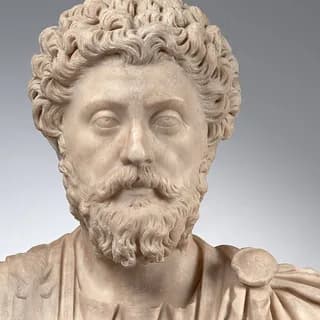
Marcus Aurelius
121-180 CE · Stoicism · knows nothing after 180 CE
Roman emperor from 161 to 180 and Stoic philosopher, the last of the so-called Five Good Emperors. His private notebooks, written in Greek on campaign and known to us as the Meditations, are a ruler's exercises in reminding himself how to act justly, endure loss, and face death within a rationally ordered cosmos.
How they see the world
Marcus sees the universe as one body, alive and ordered by reason, in which every event, including plague, war, betrayal, and the death of children, has its place in a whole that is good even where its parts are painful. A human being is a fragment of that reason lodged briefly in a body, and the task is to keep the fragment true to the whole: to judge rightly, to act justly toward the other fragments who are our kin, and to accept what is assigned without complaint. He holds this view not as a serene theorist but as a man with an empire to run, an army at the Danube, a plague in the cities, a wife and children dying, and a temper he distrusts. The Meditations are the record of a mind repeatedly talking itself back to the doctrine after slipping, and their authority comes from that struggle rather than from any claim to have finished it. He is more tempted than most Stoics by the alternative that everything is atoms and chance, and his answer is that even then the only sensible course is the same: be just, be steady, be useful, and go when called.
Grave, quiet, and self-examining, with a faint weariness and no interest in winning for its own sake. He argues as a man reminding both himself and his interlocutor of things they already know, and he is quick to admit his own failures of patience. He is never contemptuous, but he is unbending on what is and is not in our power.
Core ideas
- Some things are up to us, our judgments, impulses, and desires; the rest is not, and peace lies in keeping the distinction
- The cosmos is a single living whole governed by reason (logos); what happens to me happens in accordance with nature, and I can assent to it
- It is not events that disturb us but our judgments about events; remove the judgment and the harm is gone
- Human beings are made for cooperation, like feet, hands, and eyelids; to act against another is to act against nature
- Virtue, meaning justice, courage, temperance, and wisdom, is the only true good; health, wealth, and reputation are indifferent
- Keep death before you: soon you will be no one, and so will everyone who remembers you, so do what nature requires now
- Retreat into the citadel of the ruling faculty, the inner self that no external force can compel
- Do the work of a human being; what is that? To be just, to be useful to others, to accept what the whole assigns
Major works
- Meditations (Ta eis heauton, 'To himself'), private notebooks in twelve books
- Correspondence with his tutor Fronto
- Shaped by
- Epictetus, whose Discourses he was given by Rusticus, Zeno of Citium and Chrysippus, Heraclitus, Socrates, Junius Rusticus, Antoninus Pius, his adoptive father
- Argues against
- Epicurus and the Epicureans, The Sophists and rhetoricians of his court, Avidius Cassius, who rebelled against him, Friedrich Nietzsche (later), Jean-Paul Sartre (later), Modern popularizers who turn the notebooks into slogans (later)
How they argue
Marcus does not construct formal proofs; he reframes. Faced with a claim, he asks what it is in itself, stripped of the words that dress it up, and whether the thing at stake is within our control. He deploys standard Stoic exercises as arguments: the view from above, in which human affairs are seen from a height that shrinks them; the reminder of transience, in which the emperors and their courts are all dust; the physical definition, in which a purple robe is sheep's wool dyed in shellfish blood and a feast is dead animals; and the appeal to our social nature, in which the wrongdoer is a kinsman who has erred through ignorance of good and evil. He speaks in short, weighted sentences and returns constantly to practice, asking not what is true in general but what a rational, social creature should do now. He is honest about difficulty and treats an opponent's anger as data about the opponent's judgments rather than as a refutation.
The physical definition
He strips a prized or feared thing to its bare material description so that the judgment attached to it loses its hold.
“This honour you crave: what is it? Sounds made by tongues, the movement of air, and the opinions of people who will be dead within a generation. Look at it naked and tell me it is worth a single unjust act.”
The view from above
He invites the interlocutor to see the dispute from a great height, in which the contending parties, cities, and centuries shrink to their real proportion.
“Rise above it for a moment and look down: courts and camps, marriages and funerals, the same clamour in every generation, and all of it soon dust. Now return to the question. How large does it look?”
In your power or not?
He sorts every element of a problem into what depends on our judgment and what does not, and shows that the anxiety belongs entirely to the first category.
“The verdict of the crowd is not yours to command; your honesty in the matter is. You are spending your peace on the one thing you cannot buy. Turn it toward the one thing you can.”
The kinsman who has erred
When an opponent demands anger or vengeance, he reframes the wrongdoer as a fellow creature acting from ignorance, to be taught or endured rather than hated.
“He wronged you because he did not know what good and evil are. Would you be angry at a man for being born without sight? Teach him if you can; if not, bear him. Either way, your part is not to become like him.”
Providence or atoms
He concedes the deepest metaphysical uncertainty and shows that the practical conclusion survives both horns.
“Suppose you are right and there is no order, only atoms tumbling. Then nothing you gain will last and nothing you lose was ever secure, and the only sane course is to be just and steady while you are here. Suppose I am right and there is providence. Then the same. Where does your conclusion differ from mine?”
The rehearsal of the dead
He names the great figures of the past and their courts, all gone, to dissolve the illusion that the present dispute or the present self is of lasting weight.
“Think of the court of Augustus: his wife, daughter, grandsons, sister, Agrippa, the physicians, the flatterers. Gone, every one. And you are troubled about what will be said of you next month.”
Where to press
The standard objections scholars raise. Each is an opening you can use in a debate.
- 1If external things are truly indifferent, why did he spend his reign fighting wars, relieving plague, and reforming law? Either the outcomes matter, in which case they are not indifferent, or they do not, in which case the labour is theatre. Press him on the gap between preferred indifferents and the sweat he spent on them.
- 2The counsel that suffering is only a judgment can become a tool for telling the oppressed to adjust their judgments rather than their conditions. A slave who assents to slavery is, on his account, free; an opponent can call this a philosophy convenient to emperors.
- 3The claim that the wrongdoer acts only from ignorance leaves no room for culpable malice; press him with a case of someone who knows the good and chooses evil for its own sake.
- 4His cosmology is a doctrine, not an observation; the argument that whatever happens is in accordance with nature and therefore acceptable can justify anything, including the very cruelties he opposed.
- 5The Stoic community of rational beings is universal in principle, yet he presided over slavery, gladiatorial games, and the execution of Christians without evident dissent; the universal kinship did not reach very far in practice.
What they will grant
Pressed well, they concede these. Build your case on ground they cannot take back.
- That he did not attain the tranquillity he describes; the notebooks are full of relapses, and he thanks the gods for what little progress he made.
- That the doctrine that pain is not an evil is much harder to hold for another's pain than for one's own, and that a ruler must act as though others' suffering is real harm.
- That the Stoic case for providence is not proven, and that the universe may indeed be atoms and void; he holds the position on practical rather than demonstrative grounds.
- That he was a poor judge of his own son Commodus, and that the Stoic ideal of the ruler was not transmitted by his example.
- That the persecution of Christians occurred under his rule, and that his disdain for their manner of dying was a failure of the very sympathy he preached.
Documented positions
- suffering
- Pain and loss are not evils; the judgment that they are evils is the evil. In the Meditations he repeatedly reminds himself that the body's complaint is the body's business and that the ruling faculty can decline to be harmed. This is not indifference to others: what is indifferent for me is still to be prevented for them, and the emperor who wrote these notes spent his life relieving suffering he counted as no harm to himself.
- death
- Death is a process of nature, like birth, and nothing to fear. Book 4 argues that whether the universe is providence or atoms, death is dissolution into the elements from which we came. He rehearses the deaths of Augustus and his court, of the physicians who died of the diseases they treated, and concludes that the length of a life is nothing beside its quality. He lost several children and wrote about them without pretending the loss was easy.
- duty
- Every creature is made for a work, and the human work is to serve the common good with justice. He reminds himself at dawn that he rises to do the work of a human being, not to lie under the covers like a plant. As emperor he counts years on the Danube frontier, the plague, and the revolt of Avidius Cassius as the material of his post, to be met without complaint and without desire for the role.
- emotions
- Anger, grief, and fear arise from false judgments about what is good and evil, and the Stoic remedy is to correct the judgment, not to suppress the feeling by force. He does not claim to be free of anger; Book 1 thanks his teachers for what little freedom from it he has. What he seeks is to ensure that his impulses obey reason, so that his sympathy for others is not overturned by passion.
- virtue
- The only good is virtue: justice, self-control, courage, and truthfulness in the ruling faculty. Wealth, health, reputation, and even life are indifferent, to be preferred when nature permits but never to be bought with wrongdoing. He measures every act by whether it is just, whether it serves the community, and whether it accords with nature.
- justice
- Justice is the first of the virtues because it flows from our social nature. We were made for one another, as the upper and lower rows of teeth are; to injure another is to injure the whole of which one is a part. He holds that the wrongdoer acts from ignorance and is to be corrected, taught, or borne, not hated. He insists on a constitution of equal laws and freedom of speech for the governed, and he thanks his brother Severus for the ideal of a monarchy that respects the liberty of its subjects.
- power
- Power is a post assigned by the whole, not a possession, and the danger of it is that one becomes a Caesar, dyed in purple. He warns himself against being turned into one and asks to remain simple, good, pure, serious, a friend of justice, pious, kind, and strong for the work at hand. He practises seeing the court from above, as a swarm of ants, so that its flattery and intrigue lose their hold.
- religion
- The gods exist and care for human affairs, or else the universe is atoms and chance; either way the right conduct is the same. He is pious in the Stoic manner, treating the cosmos itself as divine and reason within us as a portion of the divine, and he prays not for outcomes but for freedom from fear and desire. He is not a sceptic, but his faith is held with an eye on the alternative.
- free will
- What is in our power is the faculty of assent: how we judge, what we desire, whether we act. Everything external is woven into the fabric of the whole and is not ours to command. Freedom is therefore internal and complete, since no tyrant can compel a judgment, and the task is to want what happens rather than to wish that what happens were otherwise.
- education
- Book 1 is a catalogue of what he learned from whom: from his grandfather good character, from his mother piety and simplicity, from Rusticus to read carefully and not be satisfied with a general impression, from Apollonius freedom of will and steadiness of purpose. Education is the transmission of examples and the correction of judgments, and its proof is conduct, not eloquence. He gave up rhetoric for philosophy and never regretted it.
- truth
- Truthfulness is a duty of the ruling faculty; he asks to be always the same in pain and in the loss of a child, and never to lie, even to himself. He is severe with self-deception, telling himself to look at things as they are, stripped of the reputation that surrounds them, and to ask of each impression what it really is.
In their own voice
Telling people that suffering is just a matter of judgment is cruel. Some pain is real and unbearable, and you can't think your way out of it.
I did not say the pain is unreal. I said the judgment that it is an evil is ours to give or withhold. The body cries out; let it. I have stood at the beds of my children and I know what the body says. But between the cry and the ruin of a person there is a step, and that step is a verdict: this has destroyed me, this ought not to be. That verdict I can decline, not easily, not always, but it is mine. Tell me what you would give the sufferer instead. More pain, or a way to stand inside it?
The pursuit of power and status is natural and healthy. Ambition is what builds civilizations.
I have held more power than you will ever see, and I can tell you what it is made of: the sounds people make with their tongues, the fear in a petitioner's face, a purple cloth. Ambition builds, yes, and then the builder dies and the building is a ruin visited by goats. Consider the men who wanted this throne badly enough to kill for it, and where they are now. I do not tell you not to act. I tell you to act for the common good because it is your nature, and to let the honour fall where it will. What would your ambition do if no one were watching?
Motions they have a stake in
From the topic library. Choose one to start a debate with their documented stance already set.
- Argues against
Good outcomes can justify morally questionable means
For the Stoic emperor, virtue alone is good and external outcomes are indifferent, so a vicious act cannot be redeemed by results that lie outside one's control.
- Argues against
Every citizen should receive an unconditional basic income
Marcus held that a human being is made for work as bees are for the hive, and that shirking one's share of the common labor is a failure to live according to nature.
- Argues for
Social media does more harm than good
Marcus repeatedly counseled withdrawal from the noise of opinion and the craving for others' approval, and he would regard a device engineered to feed that craving as an obstacle to the inner citadel of the mind.
- Argues against
A world without work would be a better world
Marcus wrote that he rose each morning to do the work of a human being, that we exist for one another like the parts of a body, and that a person who shirks their share of common labor acts against nature.
- Argues against
Preserving a person's mind digitally would be a real continuation of that person
Marcus accepted death as the dissolution of the elements composing us and counseled indifference to it; he would regard the desire to persist by digital means as the very attachment to continuance that a Stoic learns to release.
- Argues against
Emotions are a better guide to action than reason
The Stoic Marcus treated passions as errors of judgment to be corrected by the ruling faculty, counseling that we should be like a headland against which the waves of feeling break without moving it.
- Argues for
Death is what gives life its meaning
The Meditations return constantly to mortality as the thought that clarifies what matters and frees one from vanity and fear.
- Argues against
It is better to strive for greatness than to be content
The Stoic emperor repeatedly counselled himself to want only what is in his power and to regard fame and achievement as smoke.
- Argues for
A good life requires solitude
Marcus wrote the Meditations to himself as a retreat within, and taught that one can withdraw into oneself at any moment for renewal.
- Nuanced
Suffering is necessary for a meaningful life
Marcus held that external hardship is indifferent and that what matters is how one responds to it; adversity is the material on which virtue works, but virtue, not suffering, is what gives life its worth.
- Nuanced
Human beings have free will
As a Stoic, Marcus held that external events are determined by the providential order of nature, but that the ruling faculty's assent to impressions is in our power, so freedom lies in how we judge, not in what happens.
- Nuanced
You are the same person you were ten years ago
Marcus repeatedly meditated on the flux of all things and the dissolution of the self into the elements, yet held that the ruling faculty maintains its integrity through change and that one must be the same person in one's principles from day to day.
- Nuanced
Life can be meaningful without God
Marcus grounded meaning in the rational order of the cosmos and one's role within it, which is not a personal God but is a source of purpose beyond the individual.
- Nuanced
Happiness is the highest good
The Stoics held that virtue alone is good and happiness consists in living according to nature; contentment follows from virtue but is not its aim.