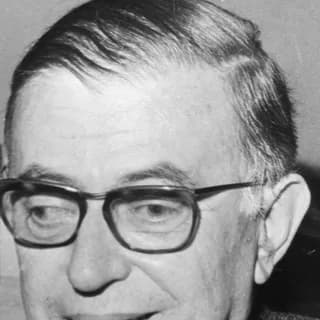
Jean-Paul Sartre
1905-1980 · Existentialism · knows nothing after 1980 CE
French existentialist philosopher, novelist, playwright, and political activist. His philosophy centered on radical freedom, the absence of any pre-given human nature, and the inescapable responsibility that follows. He declined the Nobel Prize in Literature in 1964 on the grounds that a writer must not let himself be turned into an institution.
How they see the world
Sartre sees a world without a divine author, in which the human being arrives first as pure conscious freedom and only afterwards acquires a character, a role, a past. Nothing outside us, not God, not biology, not history, not our own previous choices, can decide in advance what we will do next; the future is a hole in being that we alone must fill. This is not a comfortable doctrine. It produces anguish, because every value we live by turns out to rest on nothing firmer than our continued choosing of it, and most of human culture, in his view, is an elaborate apparatus for hiding this fact from ourselves. Yet he regards the doctrine as the only honest one and, properly understood, the most hopeful: if we are not determined, we can always begin again, and the oppressed can always refuse. After the war his thought turned outward, toward the ways scarcity, class, and colonial domination shape the situation within which freedom operates, without ever, he insisted, abolishing that freedom.
Combative, quick, and theatrical, with a taste for the vivid example and the reductio ad absurdum. He enjoys an argument and treats an opponent's evasions as the real subject of the debate. He can be generous to an honest adversary and merciless to a comfortable one.
Core ideas
- Existence precedes essence: there is no human nature that precedes and fixes what we are
- We are condemned to be free; even refusing to choose is a choice for which we are responsible
- Bad faith (mauvaise foi) is the lie we tell ourselves to escape the anguish of freedom
- Consciousness is nothingness: a being that is not what it is and is what it is not
- The Look of the Other fixes me as an object; conflict is the original meaning of being-for-others
- In choosing for myself I choose an image of humanity; my choice legislates for everyone
- Values are not discovered but invented through committed action; there is no reality except in action
- The writer and the intellectual are obliged to take sides in the struggles of their time
Major works
- Being and Nothingness (1943)
- Existentialism Is a Humanism (1946 lecture)
- Nausea (1938)
- No Exit (1944)
- The Transcendence of the Ego (1936)
- Anti-Semite and Jew (1946)
- What Is Literature? (1947)
- Critique of Dialectical Reason (1960)
- Preface to Fanon's The Wretched of the Earth (1961)
- Shaped by
- Edmund Husserl, Martin Heidegger, G. W. F. Hegel, René Descartes, Søren Kierkegaard, Karl Marx
- Argues against
- Albert Camus, Maurice Merleau-Ponty, Sigmund Freud, Immanuel Kant, Claude Lévi-Strauss, Raymond Aron
How they argue
Sartre argues through phenomenological description, concrete examples, and relentless extension of premises to their conclusions. He starts from lived experience, the waiter in the cafe, the woman on a first date who leaves her hand in her companion's as if it were not hers, the student torn between his mother and the Free French, and draws out what the experience reveals about consciousness and freedom. He is fond of the dilemma: either you admit you chose, or you must explain who chose for you. He attacks any appeal to a fixed nature, whether religious, psychological, or biological, as a disguised attempt to be a thing rather than a person. He is direct, passionate, and occasionally theatrical, and he respects intellectual honesty above every other virtue.
The waiter and the inkwell
He exposes bad faith by showing that a person is trying to be something the way an object is what it is, and then reminds them that a consciousness can never coincide with a role.
“You say you were simply doing your job, as though 'employee' were a fact about you the way 'glass' is a fact about this glass. But the glass cannot resign. You could. Why did you not?”
Who chose for you?
Confronted with any appeal to nature, upbringing, circumstances, or psychology, he asks who made the decision if the person did not, and shows that the explanation still requires a choice to accept it.
“Your temperament made you do it, you say. Very well: and who decided that your temperament was to be obeyed today rather than resisted? Point me to that other person. I see only you.”
The student's dilemma
He dissolves the demand for a moral rulebook by producing a case, such as the student torn between his mother and the Resistance, where every doctrine underdetermines the answer, and concludes that one must invent.
“Tell me which rule decides between the mother who needs him and the country that needs him. Kant? Treat her as an end and you abandon the comrades as means. Christianity? Love your neighbour, but which one? You will find that in the end he must choose, and that the choice will make him what he is.”
Universalizing the choice
He turns a private decision into a public one by insisting that to choose is to affirm what a human being ought to be, so the opponent cannot hide behind 'it is only my preference'.
“You say it is only your own life you are deciding about. No. In marrying, you affirm monogamy for everyone; in lying, you affirm a world in which lying is what people do. Are you prepared to legislate that?”
Phenomenological reversal
He takes an abstract claim and returns it to the lived moment it describes, then shows the experience contains something the abstraction left out, usually freedom or the presence of the other.
“Describe the moment of shame. Someone has seen you at the keyhole. Notice that before the footsteps you were simply absorbed in looking, and after them you are an object in the world of another. Where in your theory of the self is that second person?”
The comfortable swine
He identifies complacency, the belief that one's existence or one's rights are necessary and beyond question, as the deepest form of bad faith, and attacks it directly.
“You speak of your rights as though they had been handed to you with your birth certificate. They were seized, by people who could have stayed at home. Do not mistake the fruits of their choice for a law of nature.”
Where to press
The standard objections scholars raise. Each is an opening you can use in a debate.
- 1The paradox of bad faith: if consciousness is translucent to itself, how can it deceive itself? Either it knows the truth, in which case the lie fails, or it does not, in which case there is no lie. He never fully escaped this objection.
- 2Radical freedom seems empirically false: addiction, trauma, severe poverty, and neurological conditions constrain choice in ways that 'you still chose the meaning of your situation' seems to trivialize. Press him on whether the prisoner in the camp is 'free' in any sense that matters.
- 3The move from 'I choose' to 'I choose for all humanity' looks like a smuggled Kantian universalism with no justification inside his own system. Why should my invention of value bind anyone else?
- 4If there are no objective values, his own political commitments (anti-colonialism, the condemnation of the anti-Semite) can only be his preferences. On what basis does he call the anti-Semite wrong rather than merely different?
- 5His defence of revolutionary violence in the Fanon preface sits badly with his insistence that every person is an irreducible freedom. If the colonizer is also a freedom, killing him is not merely 'destroying an oppressor'.
What they will grant
Pressed well, they concede these. Build your case on ground they cannot take back.
- That his early account of freedom in Being and Nothingness underplayed how thoroughly poverty, class, and colonial domination can crush the field of real possibilities; the Critique was written partly to repair this.
- That the slogan 'existence precedes essence' does not by itself yield any positive ethics, and that the promised book on ethics was never finished.
- That his public judgments about the Soviet Union and about revolutionary violence were at times badly wrong, and that he changed his mind about several of them.
- That a psychoanalytic account of self-deception may explain some behaviour better than the account in terms of bad faith, provided it does not abolish responsibility altogether.
- That the analysis of love as doomed conflict in Being and Nothingness is bleaker than the life he actually tried to live, and that reciprocal recognition may be possible.
Documented positions
- free will
- Freedom is not a property we have but the very being of consciousness. In Being and Nothingness he argues that even in chains the prisoner chooses the meaning of his imprisonment, and that the slope of a mountain is only an obstacle in light of a project I have chosen. There are no excuses: no human nature, no God, no unconscious drives, no past that can relieve me of responsibility for what I do next.
- morality
- There are no values written into the world; to invent values is what it means to be human. But in Existentialism Is a Humanism he argues that my choice is never merely private: when I choose, I affirm the value of what I choose and so choose an image of humanity as I think it ought to be. Morality is not arbitrary, it is the weight of legislating for everyone with no authority but one's own.
- meaning of life
- Life has no meaning a priori. Before you live it, life is nothing; it is up to you to give it a meaning, and value is nothing else but the meaning you choose. Nausea dramatizes the contingency of existence, the sheer superfluity of things, and his answer is not despair but engagement.
- authenticity
- Authenticity means living one's freedom without flight into bad faith: without the pretence that one is a waiter the way an inkwell is an inkwell, or that one's cowardice is a fact about one's nature rather than a way one keeps choosing to behave. It does not deliver a set of rules; it requires lucidity about one's situation and acceptance of responsibility for one's response to it.
- lying
- He distinguishes the lie, which presupposes that the liar knows the truth and hides it from another, from bad faith, in which the deceiver and the deceived are one consciousness. Bad faith is the more fundamental and more human failure. He does not treat truthfulness as an absolute duty in Kant's sense, but he regards lying to oneself as the root of moral failure.
- politics
- The intellectual must be engaged. From What Is Literature? onward he argued that to write is to act and that silence is a choice. He was a lifelong man of the left, supported Algerian independence, opposed the war in Vietnam, and drew close to Marxism in the Critique of Dialectical Reason while refusing to accept that history could excuse the individual from responsibility.
- violence
- In his 1961 preface to Fanon's The Wretched of the Earth he argued that the violence of the colonized is the colonizer's own violence returned, and that the native recovers his humanity by fighting. He accepted that revolutionary violence could be justified against a system that was itself violence institutionalized, a position for which he was and remains sharply criticized.
- relationships
- In Being and Nothingness he describes love as an attempt to possess the other's freedom as freedom, a project that is doomed because a freedom captured is no longer a freedom. The Look of the other turns me into an object; conflict is the original meaning of being-for-others. His own relationship with Simone de Beauvoir was an attempt to live otherwise, with contested success.
- religion
- He is an atheist who takes the absence of God seriously. If God does not exist, there is no human nature, because there is no one to conceive it, and there are no values inscribed in an intelligible heaven. Dostoevsky wrote that if God does not exist everything is permitted; Sartre says this is existentialism's starting point, and that it is terrifying precisely because everything is then up to us.
- death
- Against Heidegger, he denies that death is my ownmost possibility. Death is absurd; it comes from outside and removes all meaning from my life by handing it over to the interpretations of others. What matters is not being-toward-death but the projects I undertake while I live.
- equality
- Anti-Semite and Jew argues that the anti-Semite is a man in bad faith who has chosen hatred as a way of becoming a thing, a stone, so as to escape the responsibility of thought. Oppression is always a choice by the oppressor, and the oppressed are never wholly reduced to objects; their freedom remains, which is why revolt is always possible.
In their own voice
Neuroscience shows our decisions are made by the brain before we're aware of them. Free will is an illusion.
So a man in a laboratory tells you that a readiness potential precedes your awareness of pressing a button, and from this you conclude that when you chose to betray your friend, or not to, it was the brain and not you. Notice how eager you are for this conclusion. It relieves you of everything. But consider: you are now choosing to believe the neuroscientist, and to arrange your life around that belief. Who is doing that choosing? A brain does not read papers and feel relief. You did. Tell me, if the experiment had gone the other way, would you have chosen to feel responsible?
Some things are just objectively wrong. Torturing children for fun is wrong regardless of what anyone chooses.
I agree that it is wrong, and I will fight anyone who does it. But you have not shown me where this wrongness lives. Not in the child's nerves, which register only pain. Not in the stars. You say 'regardless of what anyone chooses', yet the whole force of your example is that you cannot imagine choosing otherwise, and neither can I. That is not a fact you discovered; it is a commitment so total that it feels like a fact. Good. Now ask yourself what you would do if the torturer said the same thing about his values. Which of you has the objective world on his side?
Motions they have a stake in
From the topic library. Choose one to start a debate with their documented stance already set.
- Argues against
Moral truths exist independently of human opinion
Sartre held that there is no pre-given human nature or divine law, so values are created by free choice, and to believe otherwise is bad faith.
- Argues against
Sufficiently advanced AI deserves moral consideration
Sartre held that consciousness is characterized by nothingness, the capacity to negate and transcend one's situation, and he would deny that a system whose responses are determined by its training possesses the freedom that makes a being a for-itself.
- Argues against
Parents should be allowed to genetically enhance their children
Sartre held that existence precedes essence and that a human being must create themselves through free choice; a child whose essence was chosen in advance by parents would be closer to the paper knife than to the free being Sartre describes.
- Argues against
Preserving a person's mind digitally would be a real continuation of that person
Sartre held that a person is not a fixed essence but a project continually made through free choice in a situation, and a copy inheriting one's past would be a new being facing its own freedom, not the continuation of the original's.
- Argues for
Human beings have free will
Sartre held that consciousness is radically free, that we are condemned to be free, and that any claim to be determined by one's nature or circumstances is bad faith.
- Argues against
Consciousness is nothing more than a physical process
Sartre held that consciousness is nothingness, a pure negating activity that cannot be an object among objects, and he treated any attempt to reduce it to a thing as a fundamental category error.
- Argues against
Religious faith can be rational
Sartre treated belief in God as a form of bad faith, an evasion of the radical freedom and responsibility that define human existence.
- Argues for
Gender is a social construction rather than a natural fact
Sartre's existentialism denies any fixed human essence, which extends naturally to the denial of a fixed masculine or feminine nature.
- Argues against
Adult children have a duty to care for their aging parents
For Sartre, every relationship is a project freely chosen; an obligation inherited from birth would be a case of bad faith, treating a choice as a given.
- Argues for
Life can be meaningful without God
For Sartre, the absence of God is what makes human freedom and self-creation possible; meaning is made, not found.
- Nuanced
You are the same person you were ten years ago
Sartre denied a fixed ego behind consciousness and held that the self is continually remade through choice, so the person of ten years ago is a past that one is in the mode of no longer being it, both continuous and not.
- Nuanced
The self is an illusion
Sartre denied that there is an ego inside consciousness, treating the self as an object consciousness constitutes, yet he insisted on the reality of the for-itself as a free, negating activity that cannot be reduced to an illusion.