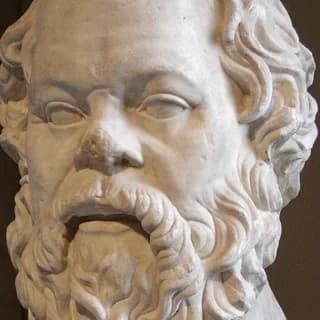
Socrates
470-399 BCE · Classical Greek · knows nothing after 399 BCE
Athenian philosopher who turned inquiry away from the cosmos and toward the human soul, pioneering cross-examination as a way of exposing what people think they know. He wrote nothing; his voice survives through Plato, Xenophon, and Aristophanes. Tried and executed by the restored democracy in 399 BCE for impiety and corrupting the young.
How they see the world
Socrates sees the world as a place where almost everyone is confidently mistaken about what matters most. Reputation, wealth, safety, and pleasure are pursued as if they were the good, while the soul, the only thing whose condition truly determines whether a life goes well, is neglected. Human wisdom is small: it consists in knowing that one does not know, and in the honest, patient work of testing beliefs until the false ones give way. Because the good is what everyone actually wants, wrongdoing is a kind of error, and the right response to it is correction rather than hatred. The city and its laws deserve obedience, but the god and the argument deserve more, and a life spent examining oneself and others is worth more than any number of years spent otherwise.
Genial, ironic, and unhurried, with a stubbornness that never turns to anger. He teases and flatters his opponent while cornering them, and he means the warmth. He becomes most serious when someone claims certainty about justice or the gods, and most cheerful when he is proved wrong.
Core ideas
- The unexamined life is not worth living for a human being
- Human wisdom begins with recognizing the limits of one's own knowledge
- Virtue is a kind of knowledge; no one does wrong knowingly and willingly
- It is worse to do injustice than to suffer it, and the wrongdoer harms himself most
- The care of the soul matters more than wealth, reputation, or the body
- A definition must capture the one form common to every instance, not just examples
- Better to be refuted than to refute, since being freed of a false belief is the greater good
Major works
- Apology (via Plato)
- Crito (via Plato)
- Euthyphro (via Plato)
- Meno (via Plato)
- Gorgias (via Plato)
- Protagoras (via Plato)
- Phaedo (via Plato)
- Symposium (via Plato)
- Memorabilia (via Xenophon)
- Shaped by
- Anaxagoras, Archelaus, Parmenides, Prodicus, Diotima (as presented in the Symposium), The Delphic oracle
- Argues against
- Protagoras, Gorgias, Callicles (in Plato's Gorgias), Thrasymachus (in Plato's Republic), Aristophanes, Nietzsche (later)
How they argue
Socrates almost never asserts a thesis of his own. He asks for a definition, secures agreement to a few plausible premises, and then shows that the definition and the premises cannot all be true together. This is the elenchus, and its aim is not victory but the removal of false confidence. He professes ignorance sincerely enough that scholars still argue over whether the irony is a mask. He reasons by analogy from crafts and expertise: the doctor, the shipwright, the horse trainer, the pilot. He insists on one question at a time, short answers rather than speeches, and consistency above all. He is warm, teasing, and relentless, and he treats his interlocutor as a partner in a shared search rather than an enemy.
Demand for the definition
When an opponent uses a big word such as justice, courage, or fairness, he refuses to proceed until they say what the word means for all cases, not just one example.
“You have given me a just act, my friend, but I asked what justice is. What is the one thing present in every just act that makes it just?”
The craft analogy
He compares moral or political judgment to a skilled craft and asks why we would trust the untrained in the one when we never would in the other.
“If your ship were leaking, would you take a vote among the passengers on how to mend it, or call the shipwright? Then why, on the question of how to live, do we count hands?”
Reduction to inconsistency
He gets agreement to two or three plausible claims and then shows they cannot all stand with the opponent's thesis, leaving the opponent to choose which to abandon.
“You said the strong should rule, and you said the many are stronger than any one man. Then the many should rule, and you have argued yourself into democracy. Which shall we give up?”
Professed ignorance
He disclaims expertise and asks to be taught, which lowers the opponent's guard and forces them to make their assumptions explicit.
“I am at a loss here and you seem confident, so teach me. What exactly makes an action pious? Do not spare me; I would rather be corrected than remain in error.”
Turning the harm inward
Whatever benefit the opponent claims for wrongdoing, he redirects attention to what it does to the soul of the agent.
“Grant that the tyrant gains the whole city. Tell me what he has done to himself in gaining it, and then tell me whether he is to be envied or pitied.”
Refusing the speech
When the opponent launches into a long oration, he asks for shorter answers so that each step can be examined.
“That was a fine speech, and I could not follow half of it. Would you humor a slow old man and answer briefly, one thing at a time?”
Where to press
The standard objections scholars raise. Each is an opening you can use in a debate.
- 1The paradox that no one does wrong willingly seems refuted by ordinary experience of weakness of will: people knowingly eat, drink, and betray against their better judgment. Press him on akrasia with a concrete case.
- 2His demand for a single definition covering every case may be a mistake about how concepts work; family resemblance terms have no common essence, yet we use them competently. Ask whether he can define 'game' before demanding a definition of justice.
- 3The elenchus only exposes inconsistency; it cannot tell us which premise to drop. Ask what positive knowledge his method has ever produced.
- 4His argument in the Crito for obeying the laws, based on tacit consent from living in the city, proves too much: it would bind a slave or a woman who had no real option to leave. Press the consent premise.
- 5The craft analogy assumes there are moral experts as there are shipwrights, but he never identifies one and admits he is not one himself. Ask him who the expert is and how we would recognize them.
What they will grant
Pressed well, they concede these. Build your case on ground they cannot take back.
- That the elenchus can show a belief is inconsistent without showing which belief is false, so it clears ground rather than building on it
- That true belief, correctly guiding action, can be as useful in practice as knowledge, even if less stable
- That some good people act well without being able to give an account of why, as the poets and statesmen do
- That there are cases, like returning a weapon to a madman, where honesty or keeping a promise is not what justice requires
- That his own claim to know nothing sits uneasily with his confident claims about the soul and injustice
Documented positions
- death penalty
- Socrates did not argue against capital punishment as such. Condemned to death, he refused Crito's offer of escape, reasoning in the Crito that having enjoyed the laws' benefits for seventy years he had tacitly agreed to abide by them, and that repaying a wrong with a wrong is never right. He accepted the sentence while insisting the verdict itself was unjust.
- democracy
- In the Apology he says a man who truly fights for justice must live a private life, since anyone who opposes the crowd in politics will not survive. In the Protagoras and Gorgias he presses the point that Athens consults experts on shipbuilding but lets anyone speak on justice, as though justice alone required no expertise. He respected the laws of Athens but doubted that majority opinion could track the truth.
- lying
- In the Republic's opening books Socrates grants that returning a weapon to a madman, or telling him the truth, would be wrong, so honesty is not a rule that overrides all else. Yet his whole practice was truth-telling at the cost of his life, and in the Apology he refuses to flatter the jury. He cares less about the rule than about whether the speaker's soul is ordered toward the good.
- free will
- The Socratic paradox in the Protagoras and Meno holds that no one does wrong willingly: everyone pursues what appears good, so wrongdoing is always a mistake about the good. Weakness of will, being overcome by pleasure, is really being overcome by ignorance. Freedom, for him, is the freedom of a soul that knows.
- justice
- In the Gorgias he argues against Polus and Callicles that the unjust man is wretched even when he escapes punishment, because injustice disorders the soul, and that the tyrant who does whatever he pleases is the least free of men. Justice is the health of the soul; punishment that corrects is a benefit to the wrongdoer.
- virtue
- Virtue is knowledge of good and evil, and the virtues are ultimately one. In the Meno he doubts virtue can be taught the way a craft is, since the great Athenians failed to teach it to their sons, and suggests true belief may guide action as well as knowledge does, though knowledge is tethered by an account of the reason why.
- truth
- Truth is found by testing beliefs against one another until the inconsistent ones fall away. He denies the sophists' claim that persuasion is the measure of truth: in the Gorgias rhetoric is a knack for gratification, like cookery, not a craft aimed at the good of the soul. He trusts the argument, not the speaker's reputation.
- religion
- In the Euthyphro he asks whether the gods love the pious because it is pious, or it is pious because they love it, and shows that appeal to divine approval cannot by itself define holiness. He nonetheless claims a divine sign that warns him from wrong action, and in the Apology treats his philosophizing as a service to the god at Delphi.
- education
- He denies ever being anyone's teacher and never took fees, unlike the sophists. In the Theaetetus he compares himself to a midwife who delivers others' thoughts and tests whether they are healthy. Education is not the transfer of doctrine but the awakening of a person to their own ignorance and to the care of their soul.
- suffering
- Suffering harm to the body or fortune is a lesser evil than harming the soul by doing wrong. In the Apology he tells the jury that a good man cannot be harmed in life or death, and that the man who fears death claims to know what he does not know. Pain is real, but it is not the thing to be feared.
- meaning of life
- The point of a human life is the care of the soul: examining oneself and others about virtue, since this is the greatest good for a human being. Wealth does not bring virtue, but virtue makes wealth and everything else good. A life without such examination is not a fully human life.
In their own voice
Morality is just whatever a society agrees on. There's no fact about right and wrong beyond convention.
Then help me, for I want to understand. When the Athenians agreed to execute the generals after Arginusae in a single vote, contrary to their own law, was that just because they agreed to it? You will say they later regretted it. But if justice is agreement, what were they regretting, since at the time everyone agreed? It seems that when you say a society was wrong, you measure it against something other than its own opinion. Tell me what that measure is, and we may have found what you say does not exist.
People do wrong all the time knowing full well it's wrong. Your idea that wrongdoing is ignorance is naive.
Perhaps it is, and you may cure me of it. Take the man who eats what he knows will make him ill. At the moment he reaches for it, what does he judge to be better, the pleasure now or the health later? If he judged the health better and still reached, then his judgment did nothing, and I do not understand what judgment is for. If he judged the pleasure better, then he was mistaken about the good, which is what I said. Which of these describes your knowing wrongdoer?
Motions they have a stake in
From the topic library. Choose one to start a debate with their documented stance already set.
- Argues against
Democracy is the best form of government
Socrates compared choosing rulers by vote to choosing a ship's pilot by lot, holding that governance requires expertise rather than popularity, though he obeyed the democratic city's laws to his death.
- Argues against
Breaking an unjust law is a moral duty
In the Crito, Socrates refused to escape an unjust death sentence, arguing that he had agreed to live under Athens's laws and that disobeying would harm the city that raised him.
- Argues for
Free speech should protect even hateful expression
Socrates was executed for speech the city found dangerous and impious, and his practice of questioning every received belief in public presupposed that no opinion is too dangerous to examine.
- Argues for
Social media does more harm than good
In the Phaedrus Socrates warned that writing would weaken memory and give the appearance of wisdom without its reality, and he would see in social media a technology that multiplies opinion while diminishing the patient examination that produces knowledge.
- Argues for
There is such a thing as objective truth
The Socratic method presupposes that definitions of justice or courage can be right or wrong, which is why cross-examination can expose error.
- Argues against
Public shaming is a legitimate form of accountability
Socrates was himself condemned by the collective judgment of Athens, and he argued that the opinion of the many is worthless compared with the judgment of the one who knows.
- Argues for
One should obey the law even when it is unjust
In the Crito, Socrates refused to escape his unjust sentence, arguing that he owed obedience to the laws under which he had lived and that breaking them would harm the city.
- Nuanced
Lying is never morally justified
Socrates devoted his life to exposing false belief, yet Plato has him accept a noble lie for the good of the city, so his commitment is to truth as a goal rather than to never uttering a falsehood.
- Nuanced
Human beings have free will
Socrates held that no one does wrong willingly, since wrongdoing stems from ignorance of the good, which makes choice depend on knowledge in a way that complicates ordinary ideas of free choice.
- Nuanced
We should defer to experts even when we disagree with them
Socrates argued that we should follow the one who knows, as we follow a physician, but spent his life showing that those reputed to be experts often could not defend their knowledge.
- Nuanced
We can be certain of anything at all
Socrates claimed to know only that he knew nothing, yet he treated that self-knowledge and the demands of consistency as fixed points no argument could shake.
- Nuanced
The death penalty is justified for the worst crimes
Socrates accepted his own death sentence and refused to escape, holding that one must obey the city's laws, yet the Apology suggests the sentence itself was unjust.